No doubt you are familiar with lectio divina, the spiritual practice of sacred reading in which you contemplate a piece of scripture or a selection of other holy reading. In lectio divina you may discover something previously unnoticed and understood, even in words you have read multiple times. As you sit with the words, the movement of God in your life may become clearer or may lead you to further examination and reflection.
The practice of visio divina or sacred seeing can be just as profound and just as much of an intimate encounter with the Divine. Christine Valters Paintner writes in her book The Soul of a Pilgrim, Eight Practices for the Journey Within, that visio divina is a "way of seeing the world with the eyes of the heart, which is the place of openness, rather than with the mind, which is often the place of planning." How good it is to remind myself to set aside my planning, list-making mind.
Paintner suggests taking a contemplative walk. Notice what you see, what touches your heart, what remains with you. What shimmers, calling for your attention? Savor the image and allow it to stir up memories or feelings or other images. Does the image summon you to a new awareness or a next step or perhaps gratefulness or compassion or openness?
Taking a picture of what you see (You have your phone with you, right?) means you can slow down your reaction to the image and bring it with you into stillness, discovering more meaning, perhaps deeper meaning.
I took this picture Sunday afternoon. What do you see?
When I came home from grocery shopping my husband was working in the front yard. We had been to a nursery after Sunday brunch, and I was not surprised to see him adding new plants to the front garden. Gardening is a spiritual practice for him, and he spends much of these gorgeous spring days adding beauty to the world.
Today, however, he was also building a relationship. As I unloaded the grocery bags from the back of the car, I heard Bruce and this preschool boy, one of our neighbors, having quite the conversation. The young boy asked Bruce if he knew the Okie Dokie Brothers. No, Bruce did not. "Who are they?" and the conversation continued. I stood on the sidewalk and just listened. It was clear I was not invited to enter into this new friendship, at least not yet. Maybe if I had a cookie to offer!
I carried my bags into the house and returned to the front stoop to eavesdrop. "Will your sisters and brother be out of school soon?" I didn't catch the response, but clearly, the little boy is an excellent conversationalist.
The rest of the afternoon I thought about these two, one young and the other many decades older, forming a relationship. I see the older man leaning on his shovel, stopping what he was doing and giving his full attention to the young man, showing him interest and respect. I saw the little boy sitting on his red scooter a few doors down from his house, clearly comfortable in his own world and reaching out to someone new. He shared information about himself, and the older man received it graciously.
I see curiosity in this photo. I see a willingness to form a connection. I see community. I see how generations can learn from each other. I see safety and warmth and ongoing creation. I am moved by the sight and feel gratitude and hope.
That's a lot to see in one simple photograph, taken quickly and without regard to composition, but the eyes of the heart are without limitation.
An Invitation
I invite you to practice visio divina occasionally this summer. What do you see? I would love to know.
Showing posts with label Christine Valters Paintner. Show all posts
Tuesday, May 22, 2018
Tuesday, May 26, 2015
Following The Memory Trail: Tuesday's Reflection
When I spoke with my father yesterday morning, Memorial Day, he mentioned remembering his father and Aunt Clara planting geraniums in pots at the cemetery on Memorial Day. Now did he say red geraniums or am I just filling in that detail? His memory made me think about pots at my parents' home planted with red and white geraniums. The front door was painted red, and my mother believed in Color Coordination. From that memory I jumped to a memory of a man who owns a small and delectable nursery. I recall his condemnation of geraniums, calling them "ordinary" and "Midwestern" and "unimaginative." That memory led me to a blustery, beyond cold evening in his home in which several gathered to read to each other from favorite books about gardening. How I happened to be there or what I or anyone else read, I don't quite recall, but I remember the evening's enveloping English coziness. I lingered in that memory for awhile, and then I meandered to our gardens at Sweetwater Farm where we didn't have any geraniums, but where the Head Gardener, husband Bruce, had open-ended space to indulge in his gardening fantasies, even if he didn't have open-ended time. He did have, however, his Undergardener, me, who weeded and followed instructions and rejoiced in his vision and hard work.
I could stay in those memories for a long time following the garden paths, feeling such gratitude for those years of privileged creativity. At the same time, I recognized it would be easy especially on a grey day like yesterday to feel loss, to detour into what I miss, but I decided, quite intentionally, to set those thoughts aside and instead return to the present.

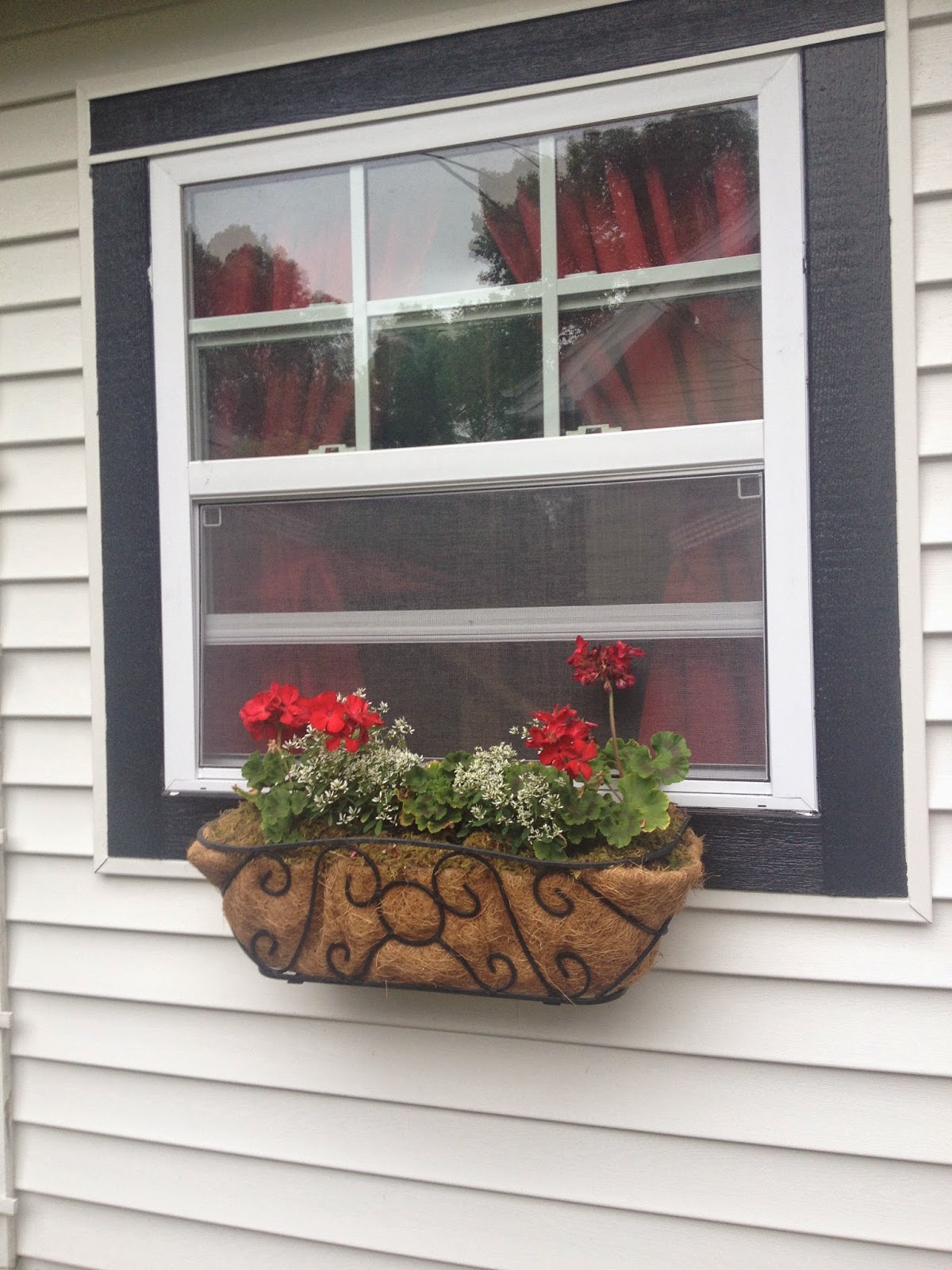
Bruce has planted geraniums, red geraniums, in the window boxes on the garage. And we even have a red door. I love the happy old-fashioned way they look, and I don't care if they are "unimaginative" or "ordinary." They remind me of a set of dishes I collected when we lived at Sweetwater Farm--a red geranium design. Whoops--there is another memory. This could go on and on, for that is what memories do.
Memories lead us on meandering paths, similar to walking a labyrinth. One turn leads to another. One more time around and still there is more pathway ahead. How easily, however, a labyrinth, which has one way in and then you follow the path in reverse to where you started, can become a maze in which you can lose your way and still not find your way out even after many tries. Sometimes being lost in memories confines us, reinforcing what actually needs to forgotten and released.
Recently,
I came across a book that invites meandering, Consolations,
The Solace, Nourishment and Underlying Meaning of Everyday Words by
the poet David Whyte. Here's what he says about memory.
Memory
is not just a then,
recalled in a now,
the past
is
never just the past, memory is a pulse, passing through
all
created life, a waveform, a then
continually becoming
other
thens,
all
the while creating a continual but
almost
untouchable now. …
We
can
be overwhelmed, traumatized, made smaller
by
the tide that brought us here, we can even be
drowned
and disappeared by memory; or we can spin
a
cocoon of insulation to protect ourselves and bob
along
passively in the wake of what we think has
occurred,
but we also have other more engaging
possibilities; memory in
a sense, is the very essence
of
the conversation we hold as individual human
beings.
A full inhabitation of memory makes human
beings
conscious, a living connection between what
has
been, what is and what is about to be. Memory
is
the living link to personal freedom. pp. 143-145
All
that from red geraniums? Yes.
Memories
as Spiritual Practice--Lectio
Divina
Spending
time in memory can become a spiritual practice when it leads us to
deeper awareness of our own essence and our connection to
something greater than ourselves. Perhaps you have heard of the
spiritual practice,
lectio divina,
which is a contemplative way to read scripture, but I think it can
be applied to memories that arise in us, as well.
I
am grateful to Christine Valters Paintner's new book The
Soul of A Pilgrim, Eight Practices for the Journey Within,
for introducing new language for the lectio divina
steps. (pp. 23-24). Why not approach memories as an exercise in
lectio
divina?
First
Movement--Lectio:
Settling and Shimmering.
When you feel a memory arise within you, give yourself time and space
to settle into it and become present. What image or words are
shimmering for you? Walk around that image, getting a good look.
Listen carefully to the words that may be part of the memory.
Second
Movement--Meditatio:
Savoring and Stirring.
Look again, feel again the memory and let imagination fill it. Are
there smells, sounds, tastes, touches, sights within this memory that
invite you? Be with them and allow the memory to grow and expand.
Third
Movement--Oratio:
Summoning and Serving.
Revisit the memory again and ask yourself why is this memory rising
within me now? Where is it leading me?
Fourth
Movement--Contemplatio:
Slowing and Stilling.
Know that this time of memory is also a time with God, the Sacred,
the Divine. Allow yourself to be, with no need to understand or
resolve. Just be.
My
lectio
divina
red geranium time led me to gratitude for the many gardens I have
known: big and small, ones I have visited and ones at our own homes,
friends' gardens, public gardens, gardens only seen in books and
magazines. My heart opened to all the beauty in the world, beauty we
participate in creating and beauty we are asked to nurture.
An
Invitation
I
invite you to open to your memories and explore them using the
spiritual practice of lectio divina. Consider journaling about your
experience. I would love to know what you discover.
Resources
David
Whyte here.
Christine Valters Painter here.
Subscribe to:
Posts (Atom)